Monday, November 7, 2011

The Canadian Health Care System


Today in Canada, healthcare is a word that has almost become a synonym amongst the population for political inefficiency. And who could blame them, with the waiting lists, and the insufficient medical coverage? But does anyone really know the rules and regulations they are relying on to save their lives? Do people really even care until they or a family member are dying because the waiting list became a race against time they lost and had to pay for instead with their lives? So many problems, and no one seems to have the answers. Or if a select few do know the facts they aren’t doing enough to inform the public because health care is and remains one of the most misinformed topics in the political system.


I’m not saying I have all the answers but I do know that the Canadian Governments, statement about health care makes me nothing but nervous. “ The basics, however, remain the same - universal coverage for medically necessary health care services provided on the basis of need, rather than the ability to pay.” This statement if of concern simply because of their usage of the word need, without defining what they are promising.


Dictionary Definition:


need [ned]


verb [trans.]

  1. require (something) because it is essential or very important


Canadian Government’s definition:


need [ned]


noun

  1. a medically relevant situation that that needs to be acted upon immediately.


But what about the medical situations that aren’t urgent? The cases where a lack of medical treatment can negatively impact a persons life in the long run? Are their needs not as important because because their condition is not as critical?


For example, a recent study in England showed that one in every 10,000 babies is effected by anopthalmia, a rare disease that results in infants being born without their eyes. You may be asking, what the problem is, since visually impaired people need relatively little medical treatment and are still capable of living a normal life. But the difference is that the children effected by this disease are still growing and developing and need glass eyeballs in order for their sockets and face to develop normally.


And yes, you guessed it, this disease, is shockingly not covered by the Canadian Health care system, since glass eyeballs are simply too expensive despite the fact that it is a necessity for the people effected by anopthalmia.

The fact is though that, "everyone as a person has the same rights as any other person," as is stated in the Deontological Principal of Equality and Justice. These people have the same right to a normal life as any of us, and they should not be deprived of that right simply because of the limited defenitions of one word. Need.


Learn more: http://www.foxnews.com/story/0,2933,584062,00.html#ixzz1d5EMNnor

http://www.hc-sc.gc.ca/hcs-sss/index-eng.php


"Pardon My Language"


Why do you need to pardon your language when you cuss? Are swear words really as bad as they're made up to be? Humanity is full of atrocities like torture, epidemics, and starvation. This list could go on. If an alien was studying the human languages, he would learn of these things and wonder why we use them in everyday language casually. "Man waiting in that lunch line was torture!" or "I'm starving!" "that video was sick." Why do we use the worst things we can possibly do in everyday language? The funny thing is as that as soon as we say a swear word like "F***", there's a huge stigma and we're considered irresponsible and a bad influence. The "F" word meaning reproducing, showing physical attraction and love between two people; one of the best things we do as a human race is "F". I might be being an egoistic person saying this, but I feel like something is wrong.
There is sometimes a stigma on words that are good words,
and the worst words are just thrown around like it's nothing.

This is a video on Stephen Fry talking about "swearing"


Being Minor: The Pros and Cons

Minor: A person under the age of full responsibility, lesser in importance, seriousness, or significance. Legally, a minor is a person under a certain age (usually 18) – which legally demarcates childhood from adulthood. Of course, being a minor is not something we can control as children or young adults. Which means that there is no way out of “being a minor”. However, whilst we are still under this category, we should take some time to observe what we can do, what we can’t do, what all this means, as well as our limitations. Should society and the government still use this term and set of rules?

Minors are always looked at as unimportant and incompetent and are seen as individuals who are not able to make their own decision. Their Guardians make major life decisions; not just because they (the minors) aren’t capable of doing so, but also because the law commands that they do so. As minors, people, often from the older generations (who, in another words aren’t minors) see us as not being capable enough to carry out functions or point our life in the right directions. This leads to my next point – As our society is progressing rigorously and the media is starting to take the reins on our communities, individuals of the younger generation start to question their place in the society, and the freedom they are allowed to possess. Now, this brings in a tricky situation, where the younger generations start to have their own mindset and ideas. Since we are in the early ages of media, the internet, connectivity throughout the world, and all that fancy stuff, it is understandable that minors, especially young adults would start to think differently, and act more aggressively than ever.

This then brings in a dilemma about who is right. Of course, for the older generations, keeping up the standard, upholding this status and our amount of freedom would be key, as they have all the right reasons to believe that keeping up this standard would allow us a bright future. As minors, we would be less mature than adults, and would not be able to weigh our options as well as someone who has lived in this world for a longer time with more experience. Yet, it has never really been tested to listen to the younger generations, as parents and the older generations generally have authority over minors, simply because of the maturity and age gap.

Of course, there is the natural positive side of being a minor. Aside from being young, free, and a juvenile, we are also given the ever- important benefit of the doubt. Although we are less important and less trusted, there are also lower expectations and a higher frequency of forgiveness. As a juvenile, the court is always lighter on us (unless in extraordinary circumstances), and in certain countries, children under the age of ten are immediately dismissed from federal disciplinary action. This is all in the name of immaturity and ignorance. So you could say that other than child slavery and exploitation, we’re pretty fortunate as minors.

Of course, this isn’t all there is to being a minor. But I believe I have touched the surface of it… You can read more about minors and their statuses in other countries here. But, bottom line? You can’t change being a minor. But as you go along in your youthful stride, enjoy the leeway and understanding you get, because it won’t last for very long.


Rex

Sunday, November 6, 2011

Your Crooked Heart


Liz Feldman once said "It's very dear to me, the issue of gay marriage. Or as i like to call it: 'marriage.' You know, because I had lunch this afternoon, not gay lunch. I parked my car; I didn't gay park it." You may be wondering why I opened up with this particular quote. In case you are, have patience young Padawan... I'm getting there. I don't understand discrimination. I don't understand homophobia. What's the point? We're all the same on the inside. Love is love, people are people. The Principle of Autonomy and Respect for Persons states that everyone has the right of self-determination subject to the equal and competing rights of others. In other words, we all have the right to well, rights. It shouldn't matter where you come from, what you believe in or if you like men, women or both. It may sound like the lyrics to the next John Lennon's Imagine , but I honestly don't see why people can't put these kinds of things behind us. Firstly, it's nobody else's business and secondly, bullying kills. And voilĂ , this is why I chose that quote. It's no one else's business who you love or marry.

As you're reading this, I'm sure you can think of too many headlines in which a child or teenager committed suicide over repeated sexual orientation and/or racist slurs. In fact, we discussed one in class the other day, which is what sparked my interest to write on this topic. I don't know about you, but I'm done with hearing those stories. I'm done with the hate and the angst. I mean, it's the 21rst century for crying out loud! We might not have the flying cars depicted in Back To The Future, but people all around the world are in the middle of rebellions and revolutions, fighting for what they believe in: the middle east with the Arab Spring, North America and Occupy Wall Street. People are trying to change, so why can't we eliminate some of these last, great weaknesses of human nature? The ostracizing and the aggression need to stop. I know we've all heard it a thousand times, and yet the message still doesn't seem to be getting through to everyone. Why the hate? What's the point? What do you benefit from hurting someone else? Nothing. Nothing is gained, and nothing every will be.

Don't get me wrong, I'm not dreaming of a utopia. I'm not saying I wish we could all get along like we used to in middle school or that I wish I could bake a cake filled with rainbows and smiles and everyone would eat and be happy like the girl from Mean Girls, but I am saying that people have the right to be comfortable in who they are. This also implies that everyone has the duty to be treated with respect. Do unto others as you would like done unto yourself. Bashing them because they don't like the same things as you is not remotely acceptable. Yet people get away with it every day. That's the truth, and I've had it with the fact that people can't put aside their beliefs and differences. Beauty and character come from our flaws and all our little imperfections. We all have faults and we all have beliefs.
In WH Auden's poem, As I Walked Out One Evening, the speaker writes "You shall love your crooked neighbour, with your crooked heart." I shall, because no one is perfect, and we could all use a little more love. Will you? Leave your thoughts in the comments.

Wednesday, November 2, 2011

Aspartame: Godly or Ghastly


Everyday throughout the world, a dieter, health fanatic or just a lover of diet foods, is faced with an ethical dilemma. Should I come to terms with calorie filled sugar? Or face the alleged cancer causing aspartame, which is used as a sugar replacement. One would most likely choose aspartame due to the large labels stating “diet” and “sugar-free” but one must consider the positive and negative benefits of aspartame on the human body.

Although the positive effects of aspartame are rarely focused on, there are numerous benefits that one must learn in order to successfully answer the ethical question of “should I use aspartame knowing it may cause many undocumented health complications?” Aspartame was first created in 1965 but was not used as an artificial sweetener until 2009, where health activists and Internet “trolls” heavily criticized it endlessly, stating it caused cancer. Many have fallen into their trap and truly believe that it does cause cancer among other things, but several studies have shown that these results were inconclusive. As a sweetener, aspartame is the best, having zero calories, being 200 times sweeter than traditional sugar, and easily made and sold so one should weigh their options by becoming fat, with loads of sugar, or eat the foods you like, with the sugary taste of aspartame.

Society has mainly focused on the negative aspects of aspartame, as many believe there are terrible health risks associated with the use of aspartame. These health risks range from cancer, as mentioned earlier, to blindness and originated from a spam email that flowed to millions of North Americans, warning people that the government is attempting to kill us with aspartame. But you need not to worry, as not one of these many diseases including multiple sclerosis, systemic lupus, methanol toxicity, blindness, spasms, shooting pains, seizures, headaches, depression, anxiety, memory loss, birth defects and other annoying symptoms, have been proven truthful by the FDA (Food and Drug Administration)

If you’d like to read more about the controversy involved with aspartame, there’s a Wikipedia page here dedicated to the American outrage at aspartame. My final thoughts are live life to the fullest; even if diet coke is going to give you cancer and you avoid it, there are millions of other products out to get you in the long run.

Patty Cakes

Thursday, June 16, 2011

Derren Brown: Mentalist or Magician?


Derren Brown is a famous illusionist from Britain who has become famous with his claim to be able to read minds. He has a number of TV shows and has proved himself to be quite an entertaining performer. He reveals very little about the tricks he plays on people, and says that it's a combination of "magic, suggestion, psychology, misdirection and showmanship". He's been creating television shows since the late 1990's and is still doing live performances today. The real question so many people have wondered is how he does it. He claims to have no stooges on his show, only real, honest people he has never met before. This also adds confusion to his ability to read minds and predict thoughts.

Saturday, June 11, 2011

Cosmic Habituation

The idea of cosmic habituation is a very new and obscure idea. However, our story does not start here. It starts with a study done by a man by the name of Schooler. His study showed that when participants were shown a video of someone robbing a bank. They got a clear shot of his face and then afterward they were asked to give a description of the man. Then seperate participants were shown the same video and then asked to pick the person out in a police line-up. What Schooler discovered was that people were, on average, 30%-40% less accurate when they were forced to pick the person out in the line up. Now this is where things get weird. When Scooler went to repeat the study months later, the findings went down. There was still a difference in accuracy but it was not near as significant as the first time. So he repeated again and again the experiment came back less and less significant. Schooler had some ideas. One of the ideas was that regression to the mean. Regression to the mean basicaly means that over time your results will get closer and closer to the actual average. In essence it meant that Schooler had simply gotten lucky, and that his new test results were going back to the actual average. However this didn't explain why it continued to get smaller and never stopped. Also other studies that were being repeated at the time were having this same problem. Not that there studies were regressing to the mean or even getting smaller, but that what they had found the first time was changing overtime and the studies, as they were repeated, were starting to prove against their findings. It was at this point that Schooler hypothesized that maybe as we study the universe around us it changes as if it were changing because of our studies. This affect was coined as cosmic habituation. There are undoubtedly problems with the theory. For example, if this affect does exist then if we study the affect we should discover that it to would change, maybe making our second and third recreations of a study, perhaps more powerful or with more proof. Also, it too would probably change making it impossible to track or study. So there really is no way to study this or even see if its real, it's always going to be a hypothetical assumption and there will most likely never be any proof. I believe it's a very creative idea but it advocates that there is no point studying the universe around us because it will be always changing.

Scam, Fraud, and Pink Bananas

⇐ Yes, that is a pink banana. Welcome to the world of the unrelated. On a completely different note, let's talk about how not to get ripped off!

In today’s world of social networking, internet marketing, and borderline-addictive cell phone use, there is an extremely large issue plaguing us. This is, of course, the issue of rampant frauds and scams on the internet. Today, I'm hoping to give you a quick guide to see past all the rhetoric (and sometimes outright lying) that you see while casually surfing the interwebs. To begin, there are some prime examples of internet scams. For the latest an greatest of these rather amusing ploys, see here. A few personal favourites are: one starving, cancer-ailed Valentin Mikhailin, the guy stuck in the middle of nowhere that desperately needs a cab (but can still somehow email thousands of people), and the guys at Microsoft that decided they wanted to hack your computer.

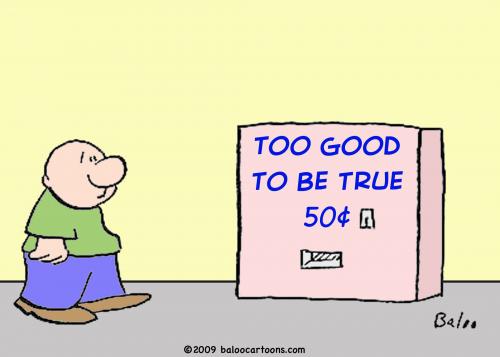
Now the first piece of advice anyone can give, but yet seems to be the most ignored, is to use your common sense! Come on people, how many Nigerian Princes do you know that really want to throw millions of dollars at you for no particular reason? Or in that case, anyone who would do that! The golden rule is to remember: nothing in life is free. Make sure to analyze those emails carefully, and think if anyone would ever actually give you what they are claiming to. As well, think about it from a business perspective; how is this company benefiting or making money of this? If you notice a major discrepancy in this, such as being offered a large gift, and the only catch being you have to send a sum of money to them (they make a profit off this money, and you might not even get your ‘gift’), then be wary of scammers. Finally, remember that if it sounds to good to be true, it probably is.

All of this covers those legal companies who deceive you into letting them make a large profit, but what about those who don't play by the rules (however vaguely)? This, Ladies and Gentlemen, is what you have to watch out for! There are some not-so-nice people out there who disregard the law and will do anything to earn a quick buck. The interesting thing about these people is that they tend to be people who have fallen for get-rich-quick schemes, are experienced, and now target
people who are desperate for money. This is scary, as it means these perpetrators of fraud are really good at what they're doing! There are three main things you have to watch out for while going about your everyday lives to help with this.

The first is constant vigilance when making purchases online. Check that the site you are at is really the site it claims to be, and not some 'phishing' site that is trying to steal your credentials. As well, make sure you get to know your seller. Meet them in person (if possible) in a public location, such as a bank. If this is not possible, then do your research! Look at their history, ask for references, and make sure you get your deal in writing.If all else fails, it might be wise to look for an alternate, more credible buyer.


The second thing is to make sure you know the contact information of your local fraud authorities, for example the RCMP Fraud Department, or RECOL. If you feel like someone is scamming you, committing fraud, or otherwise breaking the law online, it is your responsibility to report it.  Contrary to popular belief, the RCMP/Government/CIA is not some omniscient online being that can monitor anything and everything that happens. If you don't report it, nothing can be done, and you may be further endangering other people!

The third is to exercise your options! Almost all online commerce sites, such as eBay, offer buyer protection programs. Make sure you familiarize yourself with the company's policies, and how to file a complaint. Be sure to obtain all of this information before-hand, and consider using a middle-man service to ensure both parties get their fair share. And remember, if it seems too good to be true, it probably is, and there are always lots of other options.

Thursday, June 9, 2011

Laws and Consent

Should the laws pertaining to consent be changed?
The laws currently state that where there can be consent, there must be consent. Meaning that a person always has the right to decide. On top of this consent must also be informed when possible - people have the right to know (and understand) what they are consenting to. There are exceptions to this: the doctrine of emergency and the doctrine of therapeutic privilege. These are for when a person cannot give informed consent, or if they were to be informed it would cause them harm. One may think that there are appropriate laws in place now on the subject of consent and informed consent, however some people abuse these laws. For example (this is a fictional story, with fictional characters, though it could potentially happen):
A man has been drinking alcohol since noon, by 3 pm he is severely intoxicated, though tries to drive home. On the way he runs through several red lights and ends up passing out at the wheel and crossing onto the other side of the road. He then drives into the ditch, hitting a light post. Luckily no civilians are hurt. Within 20 minutes the paramedics are there, and extract the man from his car. When he gets to the hospital, he has regained consciousness but is still groggy. Right away a sample of his blood is taken, as it is suspected that he has been drinking. The doctor's examination of him reveals that he has had a sever concussion and many scrapes and bruises. The results come back, his blood alcohol level was 3 times higher than the legal limit to drive. The driver is then taken into custody and held for 24 hours until he is bailed out. He is charged with driving under the influence which could result in him losing his license, a large fine, and not being able to travel to certain countries (i.e. the US). He has a good lawyer however, who argues that the blood sample was not taken under informed consent. Due to this the prosecution makes a deal with the drunk driver, he still must lose his license for a month and pay a small fine, though his record will be ex-sponged so he will not have to worry about a criminal record.
Is it right that a driver who posed a huge threat to anyone on the road that day, was let off scot free?
The laws around consent should be altered a slight amount to prevent events such as this one from occurring.

Tuesday, May 31, 2011

How to make a free throw in Basketball 100% of the time

http://www.fearofphysics.com/cgi-bin/proj.cgi?x0=15&xunits=feet&h0=5.9&hunits=feet&v0=20&vunits=mph&theta=69&phys=on&animdetail=High&mode=wrap

It’s quite simple really; all you need is to be at the right angles every time. Professional ballers practice for literally hours every day. This allows them to make almost 100% of the shots they take in a game.

The Form:

Step 1: Slowly approach the free throw line.
Step 2: Visualize (This is crucial)
Step 3: Become one with the ball.
Step 4: Lift the basketball to hip height.
Step 5: Slowly raise ball to above your shoulder and keep elbow tucked in.
Step 6: Alter your stance to an athletic body position.
Step 7: Bend with your knees and let the ball roll of your fingertips.
Step 8: (Most important step) Finish with your hand in the cookie jar or top shelf where your dad puts the girly magazines.

Here is some footage of a real live NBA player (please watch). In this video he takes a total of 6 shots from different places on the court and only misses the last one. Incredible!

http://www.youtube.com/watch?v=XCPLEjtbusY

Sunday, May 29, 2011

Stereotypes


Stereotypes aren't true.. at least not always true. Meaning of stereotype: a thought or image about a group of people based on little or no evidence. There we go, it's based on little or no evidence which means for example not all women are emotional, and not all Americans are rude. Stereotypes reduces people or things to a category which might sometimes make it easier to make a false judgement about someone or something. People tend to make jokes out of stereotypes but again, it may be true for some, but not all. Even though there are both positive and negative stereotypes, we should not judge someone just based on that because if you say Asians are good at math in front of one who sucks at math, they might be offended.

Saturday, May 28, 2011

Rationalizing


Rationalizing is determining which side you believe, and then selecting and interpreting evidence to support it. So rationalizing is basically fake reasoning or after the fact reasoning. (Reasoning: examines the evidence, and determines which side the evidence supports. An example of this would be: “We hate Microsoft; therefore everything that goes wrong on the computer is Microsoft’s fault” (and dismisses any problems with a Mac). Just because a person hates Microsoft and thinks that everything wrong with the computer is Microsoft’s fault doesn’t mean it actually is Microsoft’s fault. It could be many things wrong with the computer so rationalizing just because something else went wrong and to blame a party for that whole problem is definitely a fallacy.

Tuesday, May 17, 2011

Video Games effect Adolescence

People have always claimed that video games have a negative effect of teenagers. But is it true and to what extent? The video game industry is a vastly growing area in the realm of entertainment, so it’s important that we understand the effect they have on kids.

Video games in general have good and bad aspects. For instance they can help improve people’s reaction time when for example you need to throw a grenade away and you only have a second to do so (Call of Duty). In the story mode of games, puzzle solving and decision making in trained. The ability of recognizing threats which is obtained in any shooter game and high speed racing games; this skill is helpful when driving a car. For all their pros games also have cons.

For instance video games can result in less physical activity, which can lead to obesity and a less healthy lifestyle. Violent video games have also been claimed to make teenagers more aggressive. This claim has been proven correct in a number of studies using MRIs to study the after effect of violence in video games. Violent video games are shown to increase emotional arousal in adolescence after game play. I believe this to be true because I have witnessed “gamer rage” before. I also think that it depends on the game as well. For example, “Call of Duty” is a fast paced shooter game, and I have seen and heard people swearing over the microphone in online multiplayer because of uneven balance in fire power. On a different note “Battlefield” game play is a little slower and has a fairer weapon arsenal. Therefore I have witnessed far less “gamer rage” and outbursts over this game. Violent video games have also been shown to desensitize kids towards fighting, killing, blood, and violent acts. This may or may not be a bad thing. On one hand teens would not feel as much mercy and regret about committing violent act towards people because it does not bother them. On the other hand I would rather have a desensitized teenager with me when a natural disaster strikes or if there is a shooting; because they would be able to react faster and think clearer without the worries of fear.

In the long run, though violent video games still do make teens more aggressive, nothing has proven that teenagers are going on killing sprees because they want to let out some steam. In fact, I bet there are fewer teens committing crimes because they’re all in the homes trying reach the next level of the game.

Monday, May 16, 2011

Clean Water, Dirty Tricks


Scare tactics have been used for centuries. From the caveman days, right up to the moment you are reading this, someone is being taken by a sly guy’s scare tactic. It’s like when you go and drive into a car lot, and ask how much that new car is, and they salesman goes off how this new Toyota is safer, with more airbags and ABS. This is when your old car is really just as safe. (Safer if you drive a Prius with the sticky gas pedal syndrome) There are millions of scare tactics in the world, some silly and some just pure genius.

Featured on CBC news’ Marketplace feature was the story of one of their reporters that went behind the scenes to uncover the scare tactics used by water purification system salesmen. These are salesmen that go around to the homes of people in American suburbia and tell them their tap water is dirty, when the fact it, the only dirty thing is them. The salesmen come to your home with a whole ‘testing kit’ and take a sample of your tap water, and a sample of their filtered water, and perform a test that was later found to be fake by scientists that are experts in that field. CBC found one elderly woman that was talked into spending $3500 on a full-home water purification system. After CBC had conducted its own tests on the water and showed the lady that bought the system, she was shocked that someone would actually be that low.

There are many people who will come to your door to try and sell you something. It’s all part of living in the ‘burbs. It’s unbelievable how many people will buy that new cast iron skillet that is way over-priced from the guy knocking on their door so they don’t get relatively harmless amounts of Teflon in their food. The salesmen tell the people how bad the effects are, when the truth is he is blowing them way out of proportion and basing his facts on small numbers.

Be it a $3500 full home water system or a guy with a pamphlet coming to your door, the population falls for scare tactics constantly. It all started with the cavemen, up until the present. The method is the same, and humanity hasn’t learned how to not fall for their tricks.

Link to CBC Marketplace’s ‘Clean Water, Dirty Tricks:’ http://www.cbc.ca/marketplace/2011/cleanwaterdirtytricks/

Saturday, May 14, 2011

The good, the bad, and the ugly of the internet

   The last few decades have proved to be some of the most influential, innovative and advancing decades of our civilization's history. Medicine, information, technology... everything has been advancing and is continuing to advance. Many people would agree that one of the biggest advancements during this time was in fact the invention of nothing other than the Internet. However, with the invention of the internet, came the good, the bad and the ugly of the web.


   The beginning of the internet would result in the beginning of the "Information Age". The internet has connected the world on a whole new scale- information is easily shared, and it has changed the way people interact, work and play. Now information can be exchanged within a matter of minutes instead of a couple of days via mail. Information is available at the tip of our fingers- anything we want to know we can access through the web. Friends and family can chat or video call while half way across the world. The internet has created a whole new platform of jobs and opportunity. It was only 30 or 40 years ago when university students had to hand write everything, when governments had a lot more hassle in order to communicate. The internet has, in no doubt, advance our communication of ideas and increased the amount of information available. However, just as the internet advances in greatness, more flaws and bad aspects of the internet are revealed.

   With so much information ready by our side, people tend to take advantage of the availability of the net. The internet is used to commit fraud, hoaxes, plagiarism and also use the internet to post non-credible resources and false claims. Things like Facebook, Twitter and other social networking sites let people post whatever information they want, and this information tends to be extremely easy to access. There are a lot of shady people out there that will use any personal information that has been shared for their own good. People have become easier targets for fraud, identity theft, and money scams, which the internet has made easier. Another negative aspect of the internet is that along with the huge amount of information presented, a lot of fake information is presented as well. Along with the bad of the internet comes the ugly of the internet.


With the introduction of online chatting and social networking came some of the ugliest aspects of the internet. Sure, you can chat with your friends and family instantly, and browse family pictures, see what your friends have been up to in the last few months and catch up with old friends. But what happens when you let a stranger into your online world? With the new availability of transforming yourself online, with a new name and face, people have done a lot of ugly things. More and more online predators have been caught in the last 10 years, and this really proves the dangers of the internet. With so much output of personal information, it has made it easier for you to be followed, and found. Little kids without any knowledge of this danger become easy targets for sexual predators.


   The good, the bad, and the ugly of the internet has been presented. You may be thinking, "Well why have the internet if it is so dangerous?"-but the answer is simple. In this day and age, the good outweigh the bad, drastically. If not, the internet would just be a useless commodity only used by the shadiest of people.

Tuesday, May 10, 2011

Irrelevant Considerations: The “Science” Behind Them

Irrelevant Considerations. That's the topic today folks, so first of all: what the heck are they? Defined in the official dictionary of Princeton University, something that is irrelevant has "no bearing on or connection with the subject at issue", and a consideration is "information that should be kept in mind when making a decision". Therefore, we can assemble that an irrelevant consideration is something that has no connection with the issue at hand, but is still used as important information to out decision-making process. Now this can be anything from people who just 'know' that someone is lying, to techniques that claim to read a person like a book, based on the colour of their shirt. Today, we're going to look at some of the "science" behind these claims, and determine how accurate they really are based on our own common sense, irrelevant or otherwise.

The first claim I found interesting was the completely unbiased, not-looking-for-a-profit, purely-science-and-facts-based writers at Forbes, who "teach" people to tell if someone is lying, based on certain 'tricks' in their face-to-face behavior. One might think that you merely need to be perceptive to master this method, but at the speed that everyday conversations move, you'd have to be someone of superhuman reflexes to "look for slight signs of dilated pupils" during brief glimpses of suspicious retellings. And even if this were possible, the author herself admits that "Psychologists who study deception... are quick to warn that there is no foolproof method". Well there goes my faith! Any "proven method" of using unrealistic skills to do something not even the experts in the field believe in is total garbage (link, bullshit) to me. Don't trust me? See the studies of a one Bella DePaulo, professor of psychology at University of California, Santa Barbara (cited in the article). No matter how hard you concentrate on someone's ever-so"slightly elevated pitch", or observe the "length of speech pauses" down to the millisecond of your subject, you wont accomplish much more than a vague idea of their ulterior motive, depending on how the 'liar' is feeling. To quote the expert: "Lying is not a distinct psychological process with its own unique behavioral indicators. It does matter how liars feel and how they think."
Man Wearing Red

The other claim I thought I would focus on is the so called "colour science" (color for our American friends). And no, I don't mean chromatics, the actual scientific studies behind the material properties of colours, and how to qualify them; I'm talking about those out-to-lunch coo-coos slightly mentally unstable individuals that believe the colour of your shirt on a given day exposes your innermost secrets! Now to begin with, I'd like everyone reading this to stop and think for a minute. When looking at a ridiculous claim such as the one presented to us here, it is always best to first ask ourselves if any of the given information conflicts with our previous experience, and background knowledge. I don't know about you, but I have never, ever felt either a "strong sexual passion" or, alternatively, somehow been terribly intimidated by someone simply because they are wearing the colour red. I can assure you that most people would not be attracted to this (in a red cardigan, or otherwise). What about some of the other colours? White: extreme cleanliness, yet my brother's white shirts would tend to disagree. Blue: Trustworthy and warm personality, but Charles Ponzi loved it! Green: Worn by people of a compassionate and relaxing nature, also happens to be the colour that the antagonizing Green Men of the Vancouver Canucks happen to wear when they wish to rile up opponents. Must we go on?

Now let's look at some of the "science" behind these claims. First things first, the source. Neither of these claims are posted by a doctor with a Ph. D., in fact, one is merely a reporter for Forbes, on anything from privatizing native lands to good hiding spots. There is no research or studies to back these claims up, no experiments to prove beyond a shred of a doubt that they cannot be false... not even a girl with a video camera walking around analyzing clothing clouds and their effects on personality. Nothing! One would think that something as sure as colour-scicence would have lots of hard evidence to claim something outrageous, but it is all just speculations from an irrelevant source. Not only that, but our common sense tells us that our close friends do not change their mood (or perspective on life), based on their quirks, or clothing colours!

The point is, these claims have absolutely no science behind them whatsoever. They cannot be tested, have no experimental data behind them, come from uneducated and irrelevant sources, and cannot be proven through the scientific method. So always remember, while some coincidences may occur, with our current scientific data, and the lack of evidence and credibility behind these claims, there is no way you're ever going to read that one elusive captor's mood, based on the colour of their hoodie. If you still believe in this stuff, I really think you need to give this a read over.

Sunday, May 8, 2011

Is using fallacies based on emotion okay?

Many people use scare tactics, which is a fallacy based on emotion, but does that mean that to use it is right or wrong?
Parents often use arguments from guilt and scare tactics to influence what their children think. If a mother tells her daughter that the oven burners are the devil's hands, so that she will not touch them and burn herself, is it wrong? The mother is trying to protect her daughter, but does that make it okay? The mothers use of scare tactics is to protect her daughter so most people would wind this situation okay, however there are people who use scare tactics to persuade people for other reasons. For example to try and scare teens out of partying, a trip to the hospital where students see patients who have been in alcohol related accidents, drug overdoses and things of this nature is arranged for all students. Is it okay to scare these teenagers out of partying by only showing the negative possibilities of partying? Is it right to use scare tactics in either situation?
People may believe that scare tactics are okay when being used to protect, or for good. Others may believe that it is not right to hyperbolize situations, that people should just be told the truth. Neither of these really matter though, people will continue to use scare tactics whether they are ethical or not.

Discrimination Against Homosexuals


Many homosexuals in the world face discrimination everyday. As sad and cruel as it is, there are many places in the world where being gay is illegal. There are laws that legalize being gay, but do not allow gay marriage. There are laws that recognize women being gay but not men. Canada, South Africa, Israel, Norway, Sweden, Belgium, the Netherlands and Spain are the only places in the world where being gay is legal, same-sex relationships are recognized, same-sex marriage and same-sex adoption is legal, homosexuals are allowed to work in the military and anti-discrmination laws are put in place for homosexuals and people who are transgender. What people need to realize is that being gay is not a crime. It has just been taboo to so many cultures and religions in the world that some people don't understand that discriminating against homosexuals is wrong.

The Westboro Baptist Church in Topeka, Kansas, is "built around a core of anti-homosexual theology" and the churches slogan is "God Hates Fags". Members of the church go to the funerals of soldiers or people who have passed away from aids and protest their hatred for homosexuals. The Most Hated Family In America is a documentary made about a family who attends the church. Religions and people like this are what make homosexuals feel uncomfortable and hated.

Hopefully one day the world will realize that being gay is not something to be ashamed of. Many places in Canada and other parts of the world have gay communities and pride marches. It's important to be proud of ones sexual status, and no one should ever feel inferior just because they're a homosexual.

Tuesday, May 3, 2011

Is Osama Bin Laden Really Dead? Conspiracy theories

On May 2nd of 2011 the US government claimed to have found and killed Osama Bin Ladin. However, many people find it somewhat strange that his body was taken to sea and buried instead of the US government keeping his body. His was apparently tested for facial recognition after being shot in the face several times, I am not to sure how recognizable his face would have been. They then claimed to have preformed genetic testing in order to further confirm that it was the body of Osama Bin Laden. It seems a little strange to many people that his body was taken withing 24 hours of his assassination to be buried. FOX news reported that "Osama Bin Laden died a peaceful death due to lung complications". By lung complication do they mean he was shot in the head and chest several times? These conspiracy theories come out of no where and often have nothing supporting them. This web page has many more examples of conspiracy theories of Osama Bin Laden: http://whatreallyhappened.com/WRHARTICLES/osama_dead.php

Why is it that we like conspiracy theories so much over the simple explanation? We are genetically made to like secrets or conspiracies because for some reason we like the fact that people lie to us, or we just like the idea of it. It also has to do with bias, many people do not like the US government so they will believe the idea that the US government is lying to them. 2 examples of this are that 9/11 was an inside job and now that Osama Bin Laden's death was faked. Conspiracies theories appeal to us because they can be twisted and involve a lot of thinking which we like. Next time you hear a conspiracy theory remember that your mind may just as well just be tricking you.

Monday, May 2, 2011

I introduce you to my favorite bottled water. This $6 per bottle water is available in Still and Sparkling form in glass bottles (375ml and 800ml), and Still in PET bottles (330ml, 500ml and 850ml).

This "special" water comes all the way from Norway.
Apparently this bottled water has an amazing taste, and it is so special it has won the best tasting water '07. The bottle was designed by former creative director for Calvin Klein.

Does this water really have a taste to it? And how do we know its actually from Norway? How do we know it's unlike other bottled water companies? Such as Alaskan Bottled water, where the water is actually from a factory in one of the southern states. Is it really worth $6?

Oh why not just spend $6 on bottled water designed by Calvin Klein?